Author Archive
Dorbot 20 at SXSW Interactive
Posted by Craig in Tesla Coils on March 15th, 2009
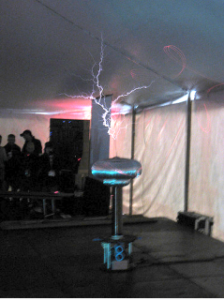 I joined Arcattack! at the SXSW Interactive, Dorkbot event last night. The event was well attended, considering the cool weather.
The venue wasn’t large enough for Arcattack’s big coils so Joe and Oliver dusted off two older coils. A few glitches came up which the guys tried to remedy. One coil would not cooperate so they had to run with one coil. Fortunately they have some new software that allows them to run multiple notes on one coil. The crowd love it, as usual, big cheers and lots of cel phone cameras were “clicking”.
Arcattack! has been using my robotic drum kit at most shows now. The controller has been fairly reliable since installing a new power transformer and a good set of fuses. Next task for the kit is solenoid mounts that can be attached to any drum set. I’d love to make two new kits, one that’s really road worthy and one that is way over the top with dual kick drums and a nice set of toms and cymbals. (I am looking for sponsors for the next round of development)
If you want to experience the full effect of Arcattack’s giant solid state coils, don’t miss the Texas Rock Fest this coming Wednesday, Thursday and Friday at 7th and Trinity in Austin. (Mar 18-20 8:45 pm to 2:00 am) Check out the Arcattack site for consise details.
The photo is from gserafini on flickr. My iphone pics wern’t worth posting.
Learning to use Microcontrollers
Posted by Craig in Electronics, Microcontrollers, Open Source software on February 22nd, 2009
If your interested in building robots, LED art or jewelry, midi controllers, (robotic drum sets) or anything else you might think of, you will need to learn how to use micro-controllers. There are many types and manufacturers to choose from.
Here are links to a few manufacturers:
Among these and other manufacturers there are a number of paths of entry with varied learning curves. A popular and fairly new product is the Arduino. This is an open source range of microcontroller boards and a free software development interface written in JAVA which is base on GNU C++. The hardware is based on ATMEL microcontrollers. The software works on Windows, Apple and Linux operating systems and is real easy to use.
I use mostly Microchip PIC controllers. I like the variety of devices available from 6 pin to 100 pin devices. There are many ways to program PIC controllers. I started using the free MPlab IDE to program chips using assembly language and a serial programmer. I then purchased PIC Basic Pro compiler from MicroEngineering Labs. I really like this product and have been surprised by the speed of the code that is produced. My Midi controlled drum kit is currently running on code written in PicBasic Pro. MELabs makes great programmers and prototyping boards as well.
Microchip sells compilers based on GCC (which is free). I’m not sure how this works but I believe you are paying for header files and such. Nice thing is, you can download a student version of the C compiler which, after 30 days produces less optimized code but works fine for most applications.
I am currently learning to use these C tools for the PIC 32 series of 32 bit controllers. These chips run at up to 80 megahertz. These are powerful devices! Wish me luck, I’ll report here on my progress.
All these choices have related pros and cons so you will have to make a choice and jump in with both feet.
Do NOT be afraid!
Craig
I use Ubuntu, and you could tu!
Posted by Craig in Open Source Electronic Music Software, Open source Graphics software, Open Source software on February 21st, 2009

I use a version of the free and open operating system called Ubuntu Linux.
I used it for a few years on a number of laptop and desktop computers with great results.
Although it may not the operating system be for your grandma, it might be great for your nephew. On the other hand if your grandma only uses email and a browser then It might fit the bill. If you have a computer around that’s orphaned and still working, you can load Ubuntu on it and give it a spin.
If you have a fast internet connection you can download what is called an ISO file from here. You then use your favorite cd burner program to create a cd. The command in your cd burner will be something like “burn cd image” or “burn ISOimage”.
The cd you end up with is a “live” cd. This means that you can boot up the machine with the CD and test drive Ubuntu before you commit to installing it. Note that your disk will be wiped clean when you install Ubuntu so make sure you copy anything important off the machine before you install.
You can “Dual Boot” fairly easily if you partition the disk properly or add a separate disk drive for Ubuntu.
There are tons of websites with helpful how-to’s on every aspect of Ubuntu and getting all your peripherals working. I have had some trouble with WiFi in the past, but more recently support is fairly good for Wifi.
I now use a Dell Inspiron 1420 for my main laptop. After installing, I got wifi, bluetooth and the nvidia graphics working without much trouble. Auto updates occur fairly regularly and I have never had a problem after an update.
I use a variation of Ubuntu Called Ubuntu Studio that has a great selection of GPL music, sound and video applications that are configured to work well together. Click on the blue icon below to go to the Ubuntu Studio website.

Pure Data- A Graphical Programming Language
Posted by Craig in Open Source Electronic Music Software, Open Source software on February 4th, 2009
Pure Data is a free graphical programming language that has shared origins with MAX/MSP (a commercial program.)
It is powerful tool for audio processiing, midi decoding and generation and open GL graphics.
You’ll want to install Pd extended.
Here are a few links:
Online book by Miller Puckette: Theory and Technique of Electronic Music
Example screenshot of code to read midi input from a Korg NanoControl.
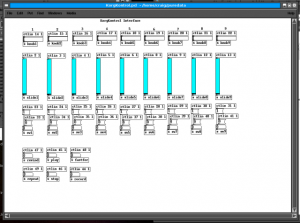
I’ll write a post soon about my initial experiments with the Korg Nano controllers.
Craig
“The Nature of Light and Colour in the Open Air”
Here is a great book about mirages, solar halos, and other atmospheric phenomena.
Why Build a Tesla Coil?
Posted by Craig in Tesla Coils on January 22nd, 2009
I suppose if you have to ask, you may never understand why so many people build these things. Mastering an elemental force like lightening is not considered, by most, to be a typical hobby. There is obviously a thrill when people see the sparks leap out of the coil and take a few steps back. There is the obvious aspect of danger and the loud sound. It’s probably similar to the attraction of fireworks.
One key motivation for me, is education. I enjoy demonstrating my Tesla coil and sharing my understanding of it. It is a joy when a teenager asks if they could build one of these. I have assisted a number of young people (with parental supervision) in building their own coils. In the process of building the coil they learn practical aspects of math, physics, materials and the general nature of craft that is required to build just about anything.
On one occasion, working with two teens on their Tesla coil. We calculated the resonance of a secondary coil then after winding it, we tested it with a signal generator and a pair of LED’s. When we found the resonance frequency and the LED’s lit brightly, one of the guys was thrilled at the notion of predicting the frequency! He was hooked and his enthusiasm increased as he worked on the coil. They also realized they had an understanding of the math involved. Wow a practical application of mathematics! Hopefully building a coil might start someone on the track to pursue an education in engineering or science.
Lots of kids are motivated to build things yet they have no sense of crafting an object. For years, we have tried to protect our young people by keeping sharp objects away from them. In our interest of keeping them safe we have reduced their ability to build things to Lego blocks. Lego are sure safe unless you have had the misfortune of stepping on one, bare foot in the dark. Let’s consider that if we let our kids ride a bike or a skateboard, we might consider that we might let them use a few hand tools.
I remember using hand saws, drills, hammers and nails when I was in grammer school. I doubt they allow children to do this any more. I have talked to engineers that did not have occasion to build or construct much of anything before they entered university!
The act of figuring out how to build a kite, a telescope, a toy boat, a model airplane, or a simple electromagnet, or just about anything, can teach a child a huge amount about the way the world works. I believe that knowledge gained this way sticks and comes in handy in what ever field a child might want to follow.
Yes I burned, cut, scraped and bashed a thumb here and there along the way. I can show you some of the scars. Would any of these injuries be a reason to stop a child from following his or her curiosity, their passion? My parents encouraged me in my interests and when it looked like I was getting into something dangerous, dad just payed a bit more attention and dad increased his supervision a bit.
Along this line I can highly recommend the book, Uncle Tungsten: Memories of a Chemical Boyhood by Oliver Sacks. My childhood was not nearly as interesting as his but it rings true. I only wish I had an Uncle Tungsten. I’m sure glad I had my Father who taught me so much, I miss him. My mom was very understanding. That reminds me, I should call her.
Craig
Time to rebuild
Posted by Craig in Tesla Coils on January 18th, 2009
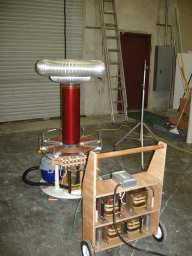
My old spark gap coil still works well. I designed it around a 100ma cold cathode lighting transformer that I lugged around for years before finally building the coil in about 1999. My old website described it in detail. (I’ll add a link here soon.) About three years ago I made some “improvements” to the coil which resulted in toasting my transformer. Its a common occurrence to kill the transformer if you don’t have a good filter to block the high frequencies from the tank circuit from getting into the neon transformer. I had a RC filter which worked great until I beefed up the wire in the tank circuit.
I purchased 6, 4500 volt 410 ma transformers from C&H sales, before they closed up shop. At someones suggestion (I’ve forgotten the website) I cascaded four of the transformers to obtain 18,000 volts at about 200ma. I added a Terry Fritz style protection filter. I also built a Jacob’s ladder out of two transformers. It makes a wicked arc!. I’ll create a page for the old coil and the Jacob’s ladder real soon. The photo here shows the old coil and the new transformer built into a wheeled cart.(It’s heavy!)

Now its time to build a new coil to match the transformer. I think I will design it to work well with a set of two transformers.
I’ll show the progress on the new coil here.
Craig
Hello world!
Posted by Craig in Uncategorized on December 10th, 2008
Hi,
My name is Craig Newswanger.
I hope to use this blog to share my projects and ideas.
Bear with me as I learn to use the various features of WordPress.

Tesla coil sparks up close.